
Cement issue 2025/6 features a wide range of interesting articles without a specific overarching theme. This issue includes, among others, articles on the Circular Arch Bridge, underwater concrete slabs, basalt fibre reinforcement, environmental performance indicators (MKI values), the thermal expansion coefficient of concrete, and the structural analysis of precast concrete sandwich façade elements.
Circular and Modular Arch Bridge
Study on modular arch bridges made of recycled and low-emission materials for cycling and pedestrian traffic
Authors:
Em. prof. ir. Rob Nijsse, TU Delft / ENS Engineers, Glass & Swinging Structures
ir. Peter Eigenraam, TU Delft / ENS Engineers, Glass & Swinging Structures
ir. Ate Snijder, TU Delft / ENS Engineers, Glass & Swinging Structures
At The Green Village, TU Delft’s field lab for sustainable innovation, a study was carried out into an innovative concept for bicycle and pedestrian bridges. The study resulted in a sustainable arch bridge design, the Circular Arch Bridge, composed of modular, reusable concrete blocks.
Column Maurice Hermens
Good standards: choose or share
In the structural engineering community, criticism of the Eurocodes is regularly voiced: they are said to be overly complex, too conservative, or obstructive to innovation. This raises the fundamental question: what makes a good standard
Variation in the Thermal Expansion Coefficient of Concrete
Section: Something Learned (1)
Author:
ir. Johan Bolhuis RO, Besix Nederland
The thermal expansion coefficient of concrete is an important material property in structural design. Its magnitude can vary significantly depending on the concrete composition. Using incorrect values may lead to undesirable consequences.
Why Underwater Concrete Slabs (Sometimes) Crack
Restrained deformations due to temperature changes in underwater concrete slabs
Author:
dr. ir. Gustaaf Bouquet
Underwater concrete slabs are susceptible to cracking, which may result in unwanted leakage. One of the causes is restrained deformation due to temperature changes and shrinkage. To better understand this influence, a concrete mix was investigated, the adiabatic temperature development was measured, and the resulting stresses were calculated.
Shear Capacity of Concrete with Basalt Stirrups
Experimental graduation research into the contribution of basalt fibre composite stirrups to shear capacity
Authors:
ir. Stefan Teeuwen, Witteveen+Bos
ir. Pieter Schoutens, Witteveen+Bos
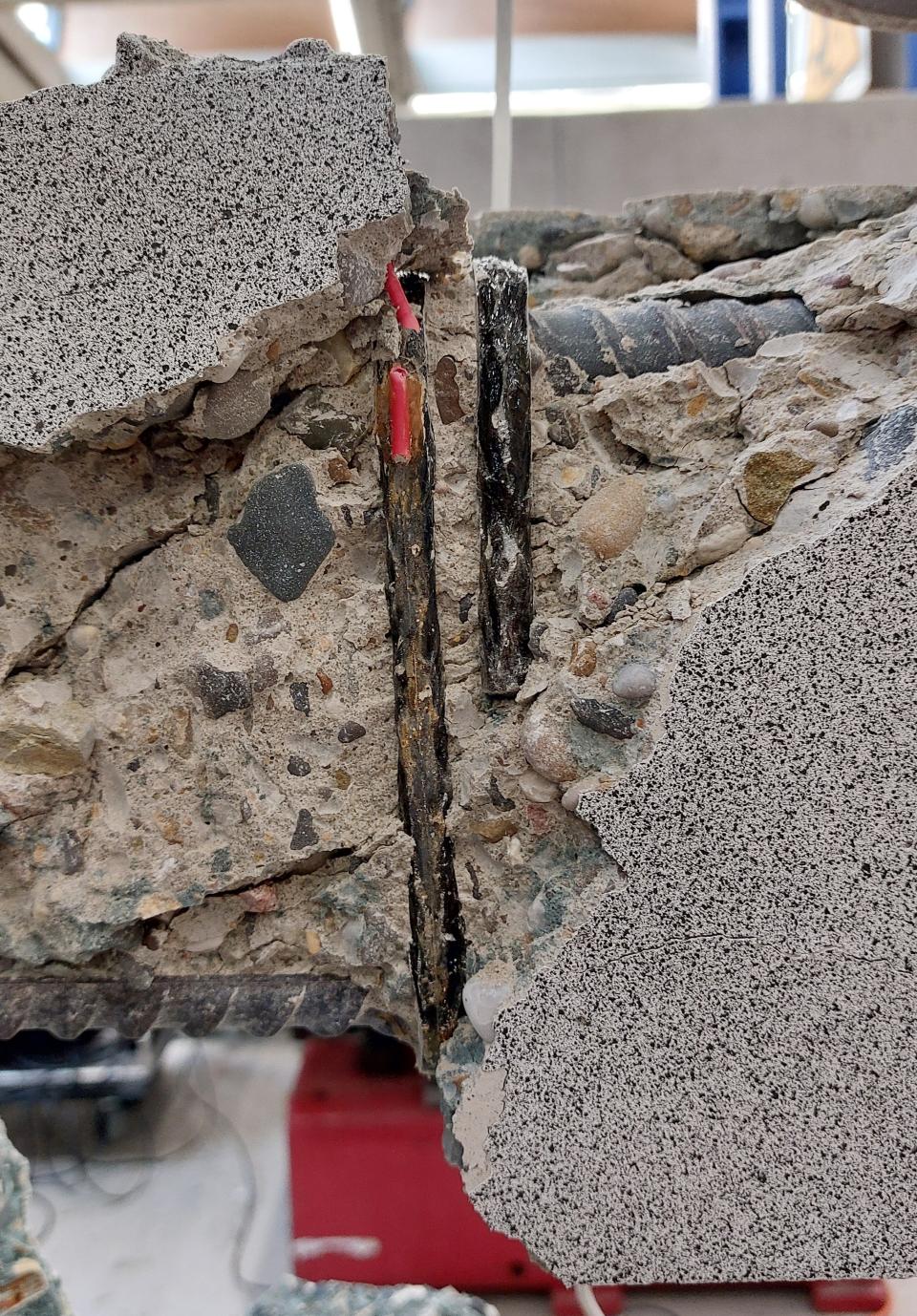
Basalt fibre composite stirrups can be used as an alternative to traditional steel stirrups. At TU Delft, research was conducted into the shear behaviour of reinforced concrete beams using basalt fibre stirrups. Six reinforced concrete beams with different stirrup configurations were tested in four-point bending tests.
Guardians of Structural Safety
Structural Engineer of the Year (2)
Author:
Rob Doomen, Pieters
In June of this year, Rob Doomen and Rayaan Ajouz were named Structural Engineer and Talent of the Year, respectively. In a series of columns in Cement, they reflect on key issues within the profession. In this installment, Rob Doomen argues that many recent construction incidents could have been prevented by the involvement of a competent coordinating structural engineer.
Big Friendly Giant Villa
Concrete in focus: Private residence ‘Sleeping Giant’, Killiney, Ireland
Author:
ir. Kirsten Hannema
Using in-situ cast concrete, O’Donnell + Tuomey Architects designed a 500 m² villa in Killiney, near Dublin, that blends into the surrounding granite hillside landscape. Through the faceted shapes of the roof and façades and the light grey colour of the concrete, the house merges with its environment. The designers recognised the silhouette of a reclining figure, reminiscent of Gulliver’s Travels, in which the protagonist washes ashore and collapses on the beach like a sleeping giant. Hence the name of the house: Sleeping Giant.
Threshold and Front-Runner Values for Sustainable Concrete
The structural engineer also plays a role in reducing environmental impact
Authors:
ing. Niki Loonen, TBI
ir. Nick Vervoort, Heijmans
On 24 June 2025, the Concrete Agreement (Betonakkoord) published a report presenting threshold and front-runner values for the environmental impact of concrete. The intention is for these values to be applied across the market, enabling clients to specify requirements consistently, contractors to adapt their construction methods accordingly, and concrete producers to align their mix designs. Structural engineers play a crucial role in this process.
Two Worlds, One Learning Path
Cooperation between the Concrete Association and Bouwen met Staal in education
In a field where steel and concrete frequently interact, collaboration is essential; not only on site, but also in education. For nearly twenty years, the Concrete Association (Betonvereniging) and Bouwen met Staal have joined forces in a series of practice-oriented training programmes for (future) structural engineers, including a post-bachelor (master-level) programme. This cooperation strengthens content quality and meets the shared demand for well-trained structural engineers.
Selected from Structural Concrete
Structural Concrete Volume 26/4 (August 2025) presents a variety of papers, with a special focus on ultra-thin shell structures made of prefabricated prestressed UHSB. For a selection of papers of particular interest to Cement readers, this article provides Dutch-language summaries:
The Future Structural Engineer
Author:
ing. Cas van den Biggelaar, Rotterdam University of Applied Sciences
A new section in Cement: The Future Structural Engineer. In this series, readers are introduced to students of Civil Engineering, Architecture, or Built Environment. In this first installment, Cas van den Biggelaar from Rotterdam University of Applied Sciences discusses his graduation project and his expectations for the future.
Structural Analysis of Concrete Sandwich Façade Elements
Practical calculations (29)
Author:
ir. Friso Janssen, Goldbeck Nederland
Many industrial and logistics buildings are equipped with concrete façades composed of sandwich concrete elements. These elements consist of an outer concrete layer, an insulation core, and an inner concrete layer. A calculation example examines the linear-elastic behaviour of such elements, cracking moments, and stiffnesses, and provides insight into their behaviour under non-linear conditions. The case considers a concrete sandwich façade element consisting of a 70 mm outer layer, a 110 mm insulation core, and an inner concrete layer.







Reacties