
The 2026/2 issue of Cement contains a wide range of interesting articles. This issue includes a series on the KJ The Hague project, an article on the assessment of half-joint connections, a summary of fib Bulletin 111, and an interview with Hans Laagland.
Bridging the Gap
Editorial introduction by Max Hendriks on the importance of concrete technology knowledge for structural engineers
Read the full article in Dutch
Four-part series on project KJ The Hague
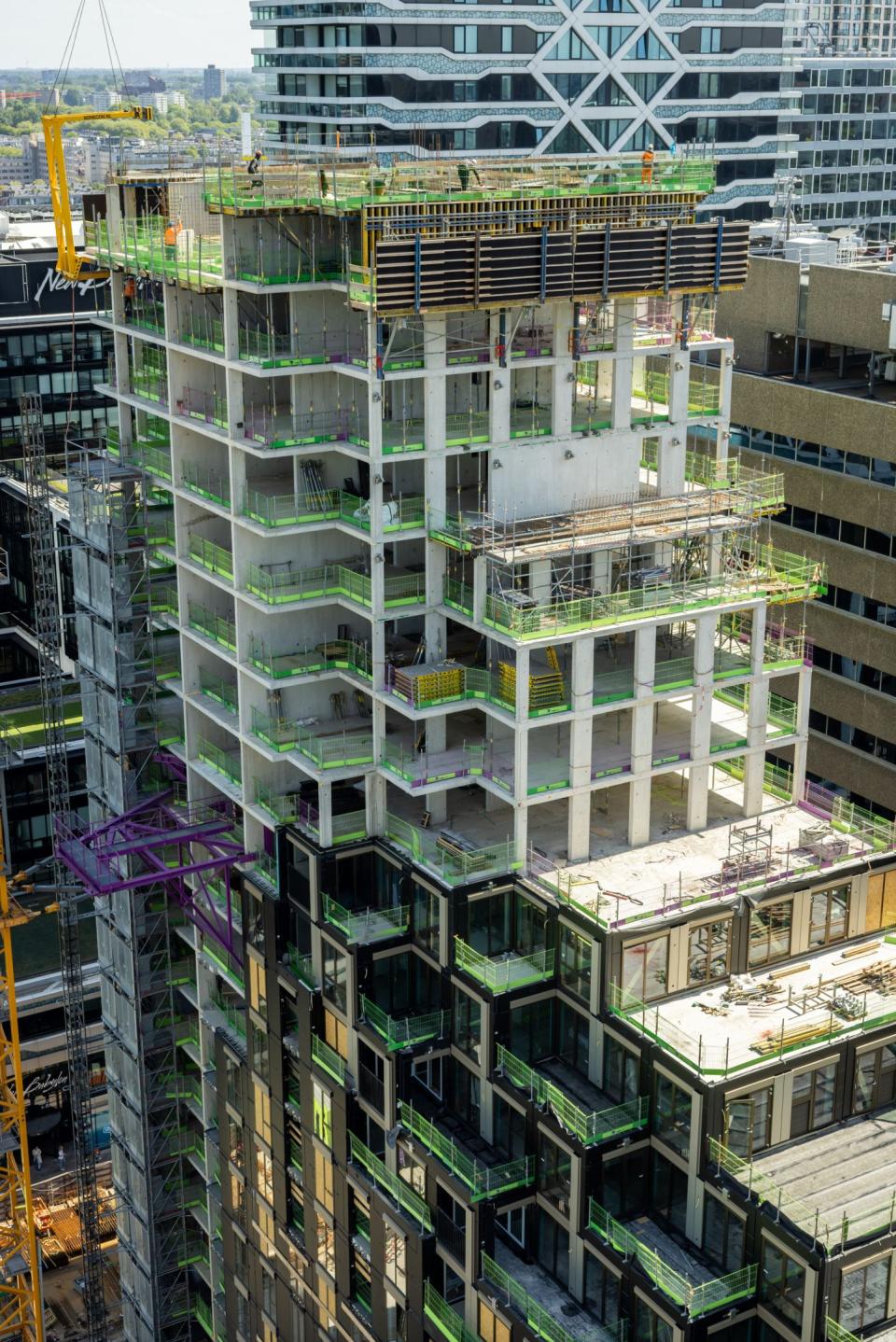
Directly in front of The Hague Central Station, KJ is under construction: a residential building with two 90 m high towers and a "valley" in between. The structure presents several challenges, such as an underlying bicycle basement and the RandstadRail line. In addition, various measures have been taken to enhance sustainability, including CO2 reduction in the concrete mix and a pilot using basalt fibre reinforcement.
Part 1 – A New Urban Gateway for The Hague
Architectural vision for KJ The Hague
Authors:
Sebastiaan van Hellenberg Hubar MSc RC, IMd
Pim Peters MSc, IMd
Paul Stavert MSc, Powerhouse Company
Koningin Julianaplein is one of the most important and most visible locations in The Hague. To use such a square as a calling card for the city, a building is being realised that is both challenging and inviting, while at the same time expressing the city's energy and ambition: KJ The Hague.
Read the full article in Dutch
Part 2 – Building Above a Bicycle Basement and RandstadRail
Explanation of the structural design of KJ The Hague
Authors:
Sebastiaan van Hellenberg Hubar MSc RC
Pim Peters MSc RO, IMd
At Koningin Julianaplein, a complex inner-city location in The Hague, KJ The Hague is taking shape. It is a large new residential building with 650 dwellings, hovering above a green square. The podium connects to the existing station hall. The assignment involved major challenges in the structural design, including ensuring stability and transferring the loads of the residential towers at ground level onto a bicycle basement. To top it all off, the future route of RandstadRail is located beneath one of the two 90 m high residential towers. As a result, a column- and foundation-free zone of 14.4 x 75.0 m2 had to be taken into account.
Read the full article in Dutch
Part 3 – CO2 Savings Through Design by Testing
Differentiation of strength classes and use of continued strength development lead to a better environmental profile
Authors:
Sebastiaan van Hellenberg Hubar MSc RC, IMd
Niki Loonen BEng, TBI
KJ The Hague is being built next to The Hague Central Station, with two 90 m high residential towers and a "valley" in between. Given its scale, a project of this kind involves the use of a large volume of concrete. In addition, high concrete strengths are required in the lower levels to enable load transfer. Together, this results in relatively high CO2 emissions. Several measures have been taken to limit the environmental impact of the structure.
Read the full article in Dutch
Part 4 – Sustainable Reinforcement at 90 m Height
Top floor of KJ The Hague partly executed with basalt fibre reinforcement
Authors:
Sebastiaan van Hellenberg Hubar MSc RC, IMd
Niki Loonen BEng, TBI
After cement, reinforcement is the largest contributor to the CO2 impact of reinforced concrete. Although the contribution of cement is almost three times greater, reinforcement also offers considerable potential for reducing CO2 impact. This can be achieved by using basalt fibre reinforcement, one of the alternatives to traditional reinforcing steel. At the KJ The Hague project, with two 90 m high residential towers and a "valley" in between, the feasibility of this was investigated for the roof slab and walls of one of the towers.
Read the full article in Dutch
fib Bulletin 111 on the Structural Behaviour of Existing Structures
Author:
Emeritus Prof. Joost Walraven
fib Bulletin 111, "Modelling structural performance of existing concrete structures", was recently published. This state-of-the-art report responds to the growing need for a basis for assessing the structural safety and remaining service life of existing structures.
Read the full article in Dutch
Interview with Hans Laagland
Author:
Jacques Linssen MSc
Design leader, project manager, innovator, 3D-printing specialist – many job titles can be attached to Hans Laagland. But even though he no longer does many calculations himself, he prefers to call himself a structural engineer. "That term conveys craftsmanship, and that is what I like so much about it." A strong dose of curiosity has characterised him throughout his life and has offered him many opportunities. As a result, he has become involved in many special projects and interesting innovations, both in the Netherlands and abroad. Time and again he has sought out renewal, often together with – and inspired by – younger generations.
Read the full article in Dutch
Zero Waste, Maximum Spatial Impact
Concrete in Focus - Thoravej 29
Author:
Kirsten Hannema MSc
The transformation of a former factory from 1967 in Copenhagen into a workspace for creative and social organisations began with the design competition launched by the Bikuben Foundation in 2021. The client opted for renovation from the ambition to realise a sustainable project. Pihlmann wanted to go one step further, with a "zero waste" transformation. Almost all materials in the building were reused, while the interior underwent a spectacular metamorphosis: from a non-descript building into an imposing space, with the concrete staircases and ribbed floor structure as defining features.
Read the full article in Dutch
Read in Structural Concrete
Structural Concrete Vol. 26/6 (December 2025) contains a variety of papers, this time with special attention to materials technology. This article provides Dutch summaries of a selection of the papers considered most interesting for Cement readers.
Read the full article in Dutch
Structural Ambition
Column – Rob Doomen, Structural Engineer of the Year (6)
“Ambition does not mean taking the easiest way out.”
Read the full article in Dutch
Reinforcing on a Grand Scale
Learned Something New (5)
Author:
Gert Visser MSEng RO, 4People
Designing reinforcement for large-scale infrastructure structures is a discipline in its own right. For structures such as fender systems, deep-sea quays, or piers of major bridges, “standard” reinforcement diameters of Ø32 and Ø40 are often used. When these need to be combined with extensive shear, torsion, and splitting reinforcement, it results in highly complex detailing. Constructability is sometimes overlooked.
For an overview of all articles in Dutch and a link to the full issue (available after login), please visit Cement 2026/2.







Reacties