
The 2026/4 issue of Cement focuses entirely on half-joints. This issue covers the challenges associated with these structural details, Rijkswaterstaat's assessment strategy, detailing using strut-and-tie models, structural assessment using non-linear finite element analyses, inspection methods, and repair strategies. These topics are illustrated with a range of practical case studies.
Rijkswaterstaat’s Approach to Half-Joints
Assessment of bridges and viaducts through the Framework Agreement for Structural Recalculations
Author:
Kees Jan van der Wilt MSc, Rijkswaterstaat
Rijkswaterstaat manages approximately 110 bridges and viaducts incorporating half-joints, most of which were constructed during the 1970s. These structural details present risks due to inadequate reinforcement detailing and corrosion resulting from leaking expansion joints and exposure to de-icing salts. As a result, many of these structures are approaching the end of their technical service life more rapidly than anticipated.
Rijkswaterstaat has developed a portfolio-based assessment strategy consisting of archive studies, targeted technical inspections, structural reassessments, and safety recommendations. Where necessary, temporary risk management measures are implemented to ensure structural safety.
Read the full article in Dutch
Detailing of Half-Joints
Explaining improperly detailed suspension reinforcement
Author:
Jacques Linssen MSc, Cement
The detailing of half-joints has received considerable attention following Rijkswaterstaat’s large-scale assessment programme for bridges and viaducts. However, the issue is not new. As early as 2006, Professor Cees Kleinman published an article warning about incorrectly detailed suspension reinforcement at beam ends. The editors of Cement provide a concise explanation of the underlying problem.
Read the full article in Dutch
A Closer Look at Strut-and-Tie Models
Selecting the appropriate strut-and-tie model and corresponding detailing is essential for the capacity of half-joints
Authors:
Rob Vergoossen MSc, Haskoning
Eelco de Winter BEng RO, Haskoning
Strut-and-tie models are widely used in the design and detailing of reinforced concrete structures, including half-joints. In practice, however, selecting the correct model and applying the appropriate force paths proves challenging for many structural engineers.
Read the full article in Dutch
Modelling Strategy for Incorrectly Detailed Half-Joints
Development of a preliminary finite element modelling strategy for structural assessment
Authors:
Ricky Tai MSc, TNO and Delft University of Technology
Gerrie Dieteren MSc, TNO
TNO has developed a preliminary modelling strategy based on non-linear finite element analysis (NLFEA) for the assessment of half-joints in Dutch bridges. The work was prompted by the discovery of incorrect reinforcement detailing in a substantial number of these structures, resulting in an increased risk of brittle failure. Conventional calculation methods appear insufficient to assess these structures reliably.
Read the full article in Dutch
Research Programme on Half-Joints at Delft University of Technology
Two research questions arising from knowledge gaps concerning half-joints
Authors:
Yuguang Yang PhD, Delft University of Technology
Ricky Tai MSc, TNO and Delft University of Technology
Although extensive international research has been carried out on half-joints, this knowledge cannot be directly applied to Dutch infrastructure. Reinforcement details specific to the Netherlands, combined with possible deterioration, make structural assessment particularly challenging.
A research programme at Delft University of Technology aims to improve understanding of the actual structural behaviour of these details and to develop reliable methods for detecting and assessing damage. The programme includes a series of full-scale experimental tests.
Read the full article in Dutch
New Inspection Method Identifies Critical Half-Joints
Targeted technical inspection of half-joints at the Prins Clausplein interchange
Author:
Ruud Meijer BEng, Concept Ingenieurs
Eight of the seventeen structures identified by Rijkswaterstaat as being at highest risk are located at the Prins Clausplein interchange near The Hague. De-icing salts carried by leaking expansion joints threaten the reinforcement embedded within the concrete.
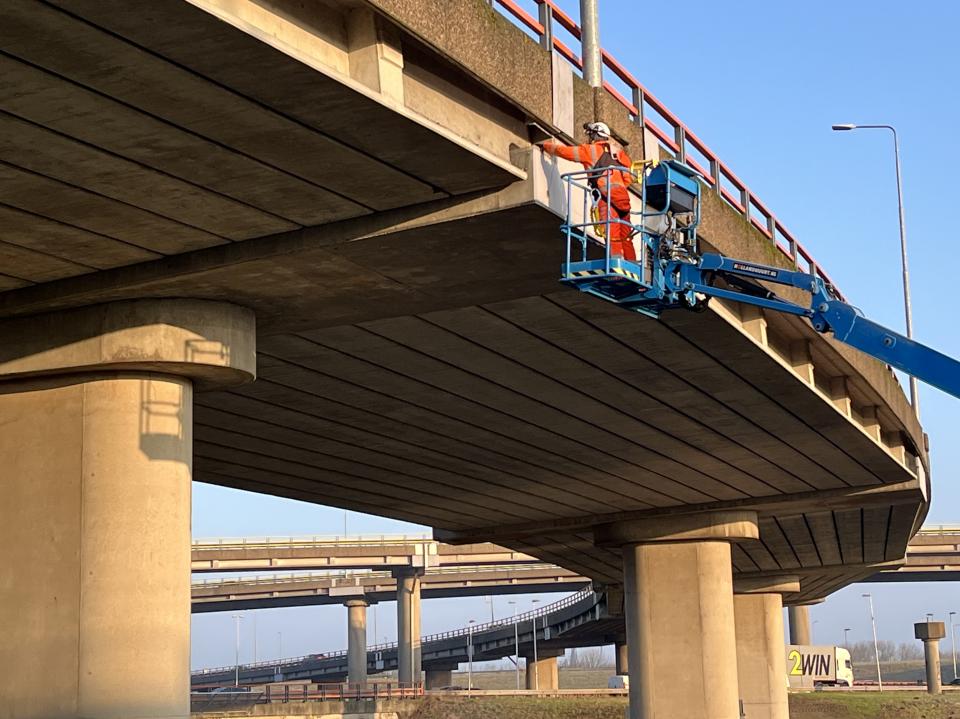
Because the relevant structural components are difficult to access, previous inspections were limited to visual observations using an endoscope. Following the development of dedicated inspection tools and a successful pilot project in 2022, these inaccessible areas could finally be examined thoroughly, resulting in a reliable diagnosis of their condition.
Read the full article in Dutch
Risk-Based Structural Safety Assessment
Reassessment of half-joints at the Prins Clausplein interchange
Authors:
Douwe Haarsma MSc, Haskoning
Rob Vergoossen MSc, Haskoning
In many concrete viaducts with half-joints, leaking expansion joints and chloride ingress create uncertainty about the condition and load-bearing capacity of the structure. Since the reinforcement detailing in many existing half-joints does not comply with current standards, conventional linear calculation methods are inadequate for reassessment.
Non-Linear Finite Element Analyses (NLFEA) provide a powerful alternative for demonstrating structural safety. Within the Structural Reassessment Programme, Rijkswaterstaat and six engineering consultancy teams jointly assess these structures. The half-joints at the Prins Clausplein interchange are among the structures investigated.
Read the full article in Dutch
Temporary Supports for the Velperbroek Interchange Viaducts
Targeted technical inspections lead to risk management measures
Authors:
Kees Jan van der Wilt MSc, Rijkswaterstaat
Frank Beers MSc, Rijkswaterstaat
Assessment of the viaducts at the Velperbroek interchange showed that the half-joints posed a high risk of deterioration and insufficient structural safety. Based on further investigations, appropriate risk management measures were recommended.
Read the full article in Dutch
Causes and Consequences of Damage to the Nelson Mandela Bridge
Looking back at the closure of the Nelson Mandela Bridge over the A12 near Zoetermeer due to cracking in a half-joint.
Author:
Jacques Linssen MSc, Cement
At the end of 2022, the Nelson Mandela Bridge crossing the A12 motorway near Zoetermeer was closed after cracking was discovered in one of its half-joints. Investigation showed that structural safety could no longer be guaranteed.
This article summarises the investigation results and the measures that were subsequently implemented.
Read the full article in Dutch
Half-Joints in Local Infrastructure
Risk-based management of bridges and viaducts incorporating half-joint supports
Author:
Maurice van Heesch MSc, Wagemaker
The challenges associated with half-joints are not limited to the national road network. Regional and municipal authorities face similar issues. Unlike Rijkswaterstaat’s highly detailed – and consequently costly – assessment strategy, the City of Amsterdam has adopted a ‘family-based’ approach, starting with broad assessments before focusing on individual structures where necessary.







Reacties