The 2026/1 issue of Cement contains a wide range of interesting articles. This issue includes a series on the project The Ensemble, a series on the IABSE Congress in Ghent, and an article on the design of pile foundations.
Dossier The Ensemble
Three-part series on the high-rise project in Amsterdam-Zuidoost
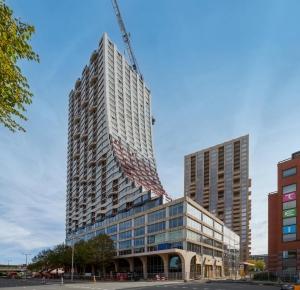
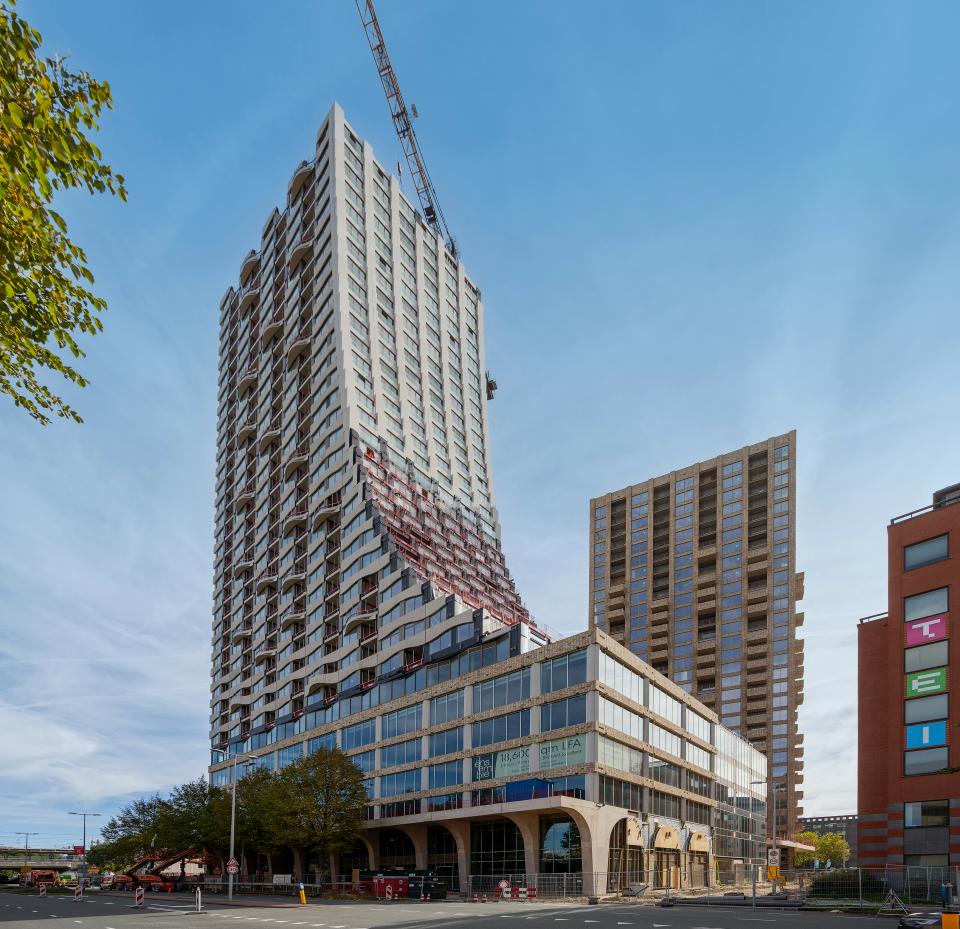
A remarkable new high-rise project is currently under construction in Amsterdam-Zuidoost: The Ensemble. The development consists of two towers, a six-storey podium, and a two-level underground parking garage. Structural highlights include the conversion of the towers from in-situ to precast concrete, a pile-raft foundation, and an integrated underwater concrete slab.
Part 1 – Pushing the Boundaries
Structural design of The Ensemble
Authors:
Arie-Jan van Renswoude MSc, ABT
Mark ter Steege MSc RC, ABT
In the new Amstel III district in Amsterdam-Zuidoost, a remarkable mixed-use building is currently rising: The Ensemble. The design includes, among other elements, two tall residential towers.
The structural design was optimized compared to the reference design. The towers were converted from cast-in-place to precast concrete. The traditional piled foundation and underwater concrete slab were replaced by a pile-raft foundation and an integrated underwater concrete slab. These optimizations resulted in significant savings in time and cost.
Read the full article in Dutch
Part 2 – Insightful Foundation Design
Understanding the interaction between foundation and superstructure through an iterative calculation process
Author:
Arie-Jan van Renswoude MSc, ABT
For The Ensemble project in Amsterdam-Zuidoost, an innovative pile-raft foundation was applied beneath two towers of 100 and 120 metres high.
Through an intensive, iterative calculation process using two software packages, the traditional foundation design with 604 piles was optimized to just 49 piles. The additional computational effort paid off in substantial savings in cost, material use, and construction time.
Read the full article in Dutch
Part 3 – Integrated Underwater Concrete Slab Without Leakage
Reduced slab thickness thanks to an integrated floor combined with an innovative dewatering scheme
Author:
Martijn Apon MSc, ABT
For The Ensemble project, an integrated underwater concrete slab was applied beneath the two high-rise towers. To limit the risk of water-bearing cracks, groundwater was pumped out at an early stage.
Read the full article in Dutch
What Buildings Whisper to Us
Column – Rico Zweers
“The true strength of an existing structure lies not in the formulas, but in the nuances.”
Read the full article in Dutch
Dossier IABSE Congress Ghent 2025
Three articles on the annual IABSE congress in Ghent
From 27 to 29 August 2025, the annual IABSE Congress took place in Ghent. During the event, organized by IABSE Netherlands and IABSE Belgium, the international community of bridge engineering and structural design came together to share knowledge, engage in discussion, and inspire one another. The theme of this edition was “The Essence of Structural Engineering for Society.”
Part 1 – Looking Back at IABSE Congress Ghent 2025
Theme: The essence of structural engineering for society
From 27 to 29 August, the IABSE Congress Ghent 2025 brought together the international bridge engineering and structural design community. The congress focused on The Essence of Structural Engineering for Society, emphasizing that structural engineering is not only about safety and reliability, but also about sustainability, efficiency, and societal value.
What were the highlights and what lessons were learned?
Read the full article in Dutch
Part 2 – Learning from Lessons of the Past
Keynote lecture at the IABSE-congress 2025
Author:
Dick Hordijk PhD
When is a structure safe enough? And what influence do modern computational technologies have on this question? Dick Hordijk addressed these issues during his keynote lecture at the IABSE Congress in Ghent. One of his conclusions is that more attention should be given to detailing, particularly in so-called D-regions. High-quality research and education are also essential.
Read the full article in Dutch
Part 3 – Lessons from the IABSE Congress
During the 2025 IABSE Congress in Ghent, 333 papers were presented on bridge engineering and structural design. The focus was not only on technical aspects, but also on the societal role of the profession. This article presents Dutch summaries of a selection of papers considered particularly interesting for Cement readers, including:
Read the full article in Dutch
The Digital Structural Engineer: Craftsmanship with Extra Tools
Column – Rayaan Ajouz, Talent of the Year
“Verification distinguishes automation as craftsmanship from automation as a mere trick.”
Read the full article in Dutch
Concrete Connects Old and New
Concrete in Focus: Swiss National Museum, Zurich, Switzerland
Author:
Kirsten Hannema MSc
More than a century after its opening, the Swiss National Museum required additional space and a thorough renovation. Strict requirements were imposed regarding indoor climate, sustainability, and safety. Because of its thermal mass, freedom of form, and solid appearance, the architectural firm Christ & Gantenbein chose concrete as the primary material. The structure consists of an 80 cm thick load-bearing inner shell made of recycled concrete. A layer of rigid insulation was applied on top, functioning as permanent formwork against which the outer shell of “tuff concrete” was cast. The outer shell is suspended from the inner shell by anchors cast into the concrete.
Read the full article in Dutch
The Young Structural Engineer – Koen Aardoom
In the “Young Structural Engineer” section, we meet Koen Aardoom of IMd Consulting Engineers. He discusses one of his first projects, the new Metterswane in Nijmegen, and shares his views on the structural engineering profession.
Read the full article in Dutch
Pile Foundations: Design First, Then Calculate
Learned Something New (4)
Author:
Meindert Verwoerd MSc
“Think first, then act.” This well-known expression also applies to structural engineering. Many engineers quickly turn to the computer (= acting) and forget to take the time to analyse and fully understand their structural component (= thinking). A clear example is the design of pile foundations for viaducts and bridges. Many such foundations are neither effective nor efficient. The traditionally common approach — designing a pile foundation as a statically determinate structure with purely hinged connections — has been largely abandoned with the increase in computational power and the use of advanced calculation models.
For an overview of all articles in Dutch and a link to the full issue (available after login), please visit Cement 2026/1.







Reacties