
Cement issue 2025/8 presents a wide range of interesting articles. This issue includes, among others, an article on the Strijp TX project, Artificial Intelligence, geopolymer concrete, non-destructive testing, the collapse of the Carola Bridge in Dresden, and misplaced anchors.
From Machine Factory to Modern Office Building
Transformation of Building TX at Strijp T in Eindhoven
Authors:
ir. Dirk Ploegmakers, ir. Marc Nijenhuis, Adviesbureau Van de Laar
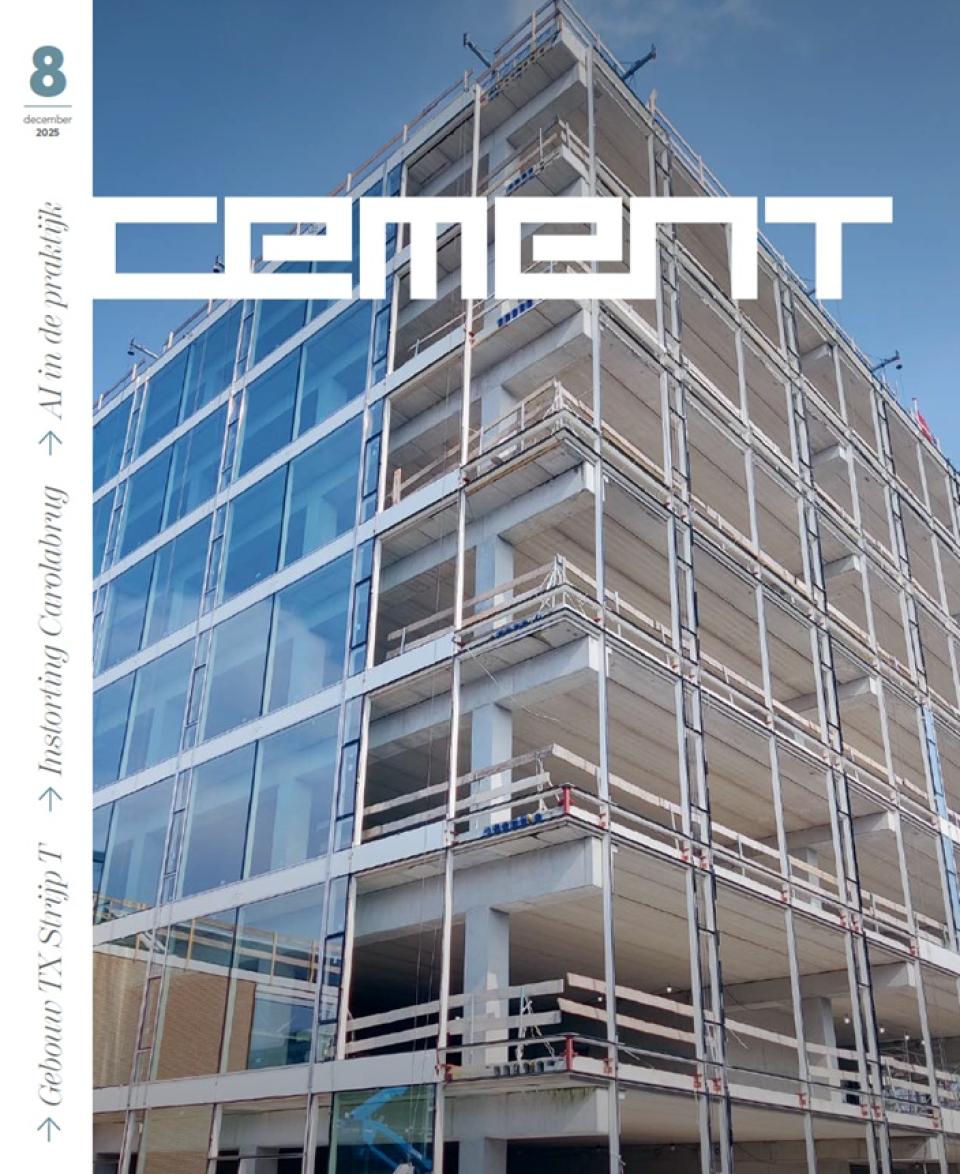
In the mid-twentieth century, machines for the production of Philips televisions and X-ray equipment were manufactured here. In a few years’ time, the building will be bustling as a modern multi-tenant office building: Building TX at Strijp T in Eindhoven. The transformation of this iconic structure is well underway and involves several interesting structural interventions.
Geopolymer Concrete for Infrastructure Applications (3)
Structural behaviour of prestressed geopolymer concrete girders
Authors:
Zhenxu Qian, dr. Mladena Lukovi?, dr. Guang Ye, dr. ir. Shizhe Zhang, TU Delft
prof. dr. ir. Stijn Matthys, Ghent University
Hendrik Herder, Haitsma Beton
ir. Arend Scharringa, Province of Fryslân
In recent years, the structural behaviour of reinforced beams made of alkali-activated concrete (also known as geopolymer concrete) has attracted increasing attention from the research community. However, only limited research has been conducted on prestressed geopolymer concrete. The long-term behaviour of such girders remains largely unknown.
Non-Destructive Testing of Reinforcement Diameter and Position
Research into the reliability of non-destructive testing methods for determining reinforcement configurations in reusable concrete elements
Authors:
ir. Jilke Donkervoort, ir. Pim Peters RO, IMd Consulting Engineers
prof. ir. Simon Wijte, Eindhoven University of Technology / Adviesbureau Hageman
Successful reuse of existing concrete elements requires reliable information about concrete cover and the position and diameter of reinforcement. Within the framework of the international ReCreate project, research was conducted into the reliability of non-destructive testing methods to determine this information. The results show that, without structural expertise and local destructive verification, non-destructive testing alone is unreliable.
Hydrogen-induced stress corrosion cracking of Carola Bridge Collapse
Summary of German research findings
Author:
Jacques Linssen, Cement
More than a year ago, the Carola Bridge in Dresden collapsed. Hydrogen-induced stress corrosion cracking (hydrogen embrittlement) was identified as the cause, according to research conducted by TU Dresden and Marx Krontal Partner. Cement summarises the findings of this investigation and discusses the implications for the Dutch situation.
Hybrid Workflows: AI in Practice
How to combine AI with existing expertise and tools
Author:
ir. Nynke ter Heide, Vidabo
In 2022, the RoboCon study group presented a future vision in Cement: automation would start at the computational core and gradually expand to other stages of the design process. Since the breakthrough of AI, reality has proven more complex, and more interesting. AI does not appear step by step in a linear manner, but everywhere at once: in text analysis, variant generation, reporting, and even tool programming. Not as a replacement, but as a partner.
Misplaced Anchors
Section: Something Learned (3)
Author:
ing. Frank van der Woerdt, Ballast Nedam Infra Projects
In concrete structures intended to support steel structures, connections with cast-in anchors are common. Critical aspects include dimensional accuracy and placement tolerances. While tight tolerances are relatively easy to achieve in the fabrication of steel components, accurate positioning of cast-in elements such as anchors in concrete proves considerably more difficult. This often leads to execution problems on site.
Triangular Relationship
Concrete in focus: Provincial Government Building, Antwerp, Belgium
Author:
ir. Kirsten Hannema
The new Provincial Government Building in Antwerp, replacing the 1970s structure, consists of a two-level podium containing the congress centre and underground parking garage, with a 59-metre-high office tower placed perpendicularly on top, supported on ‘legs’. To avoid overshadowing surrounding buildings, the façades of the tower are rotated southwards over eight storeys, creating a dramatic, gravity-defying effect.
The building required an open floor plan with large spans. In the podium, a large steel truss spans between the concrete lift cores. Two additional steel trusses are integrated into the concrete façades; their triangular shape defines the geometry of the façade openings.
The Future Structural Engineer – Levy Wolters
In the section The Future Structural Engineer, we are introduced to a student of Civil Engineering, Architecture or Built Environment. In this installment, Levy Wolters, a graduate of HAN University of Applied Sciences, discusses his graduation project (a hollow-core slab made of geopolymer concrete) and his expectations for the future.
Building Structures Is Sexy
Column – Rob Doomen, Structural Engineer of the Year
“Structural talent is being lost to socially less relevant positions than that of structural engineer.”
And Now for Something Completely Different
Column – Maurice Hermens
“The statement ‘the structure does not meet the rejection level’ is often incorrect.”
Selected from Structural Concrete 26/5
Structural Concrete Vol. 26/5 (October 2025) presents a variety of papers, with a special focus on ultra-thin shell structures made of prefabricated prestressed UHSB. This article provides Dutch-language summaries of a selection of papers of particular interest to Cement readers.
Selected papers include:







Reacties